Reasoning Agent
A Reasoning Agent is designed for structured multi-step thinking. It doesn’t just generate a single response — it explores different reasoning paths, evaluates them, and selects or pools the best answers.
This agent is best used when decisions require evaluation, ranking, or planning — such as chain-of-thought tasks, multi-step reasoning, or agent voting.
Basic Setup
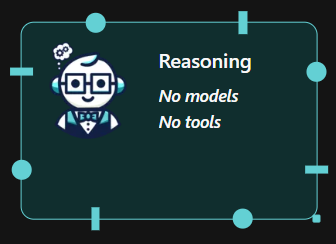
- Name & Description: Customize how the agent is labeled in your flow.
- System Message: Define the reasoning agent's behavior or role.
- Human Input Mode: Whether to ask for human inputs every time a message is received. Possible values are:
- Always: The agent prompts for human input every time a message is received. Under this mode, the conversation stops when the human input is "exit", or when is_termination_msg is True and there is no human input.
- Terminate: The Agent only prompts for human input only when a termination message is received or the number of auto reply reaches the max_consecutive_auto_reply.
- Never: The agent will neever prompt for human input. Under this mode, the conversation stops when the number of auto reply reaches the max_consecutive_auto_reply or when is_termination_msg is True.
- Max Consecutive auto reply: The maximum number of consecutive auto replies (i.e., when no code execution or LLM-based reply is generated). Default is None (no limit provided). When set to 0, no auto reply will be generated.
- Defautl Auto Reply: Set a Default auto reply.
Reasoning Tab
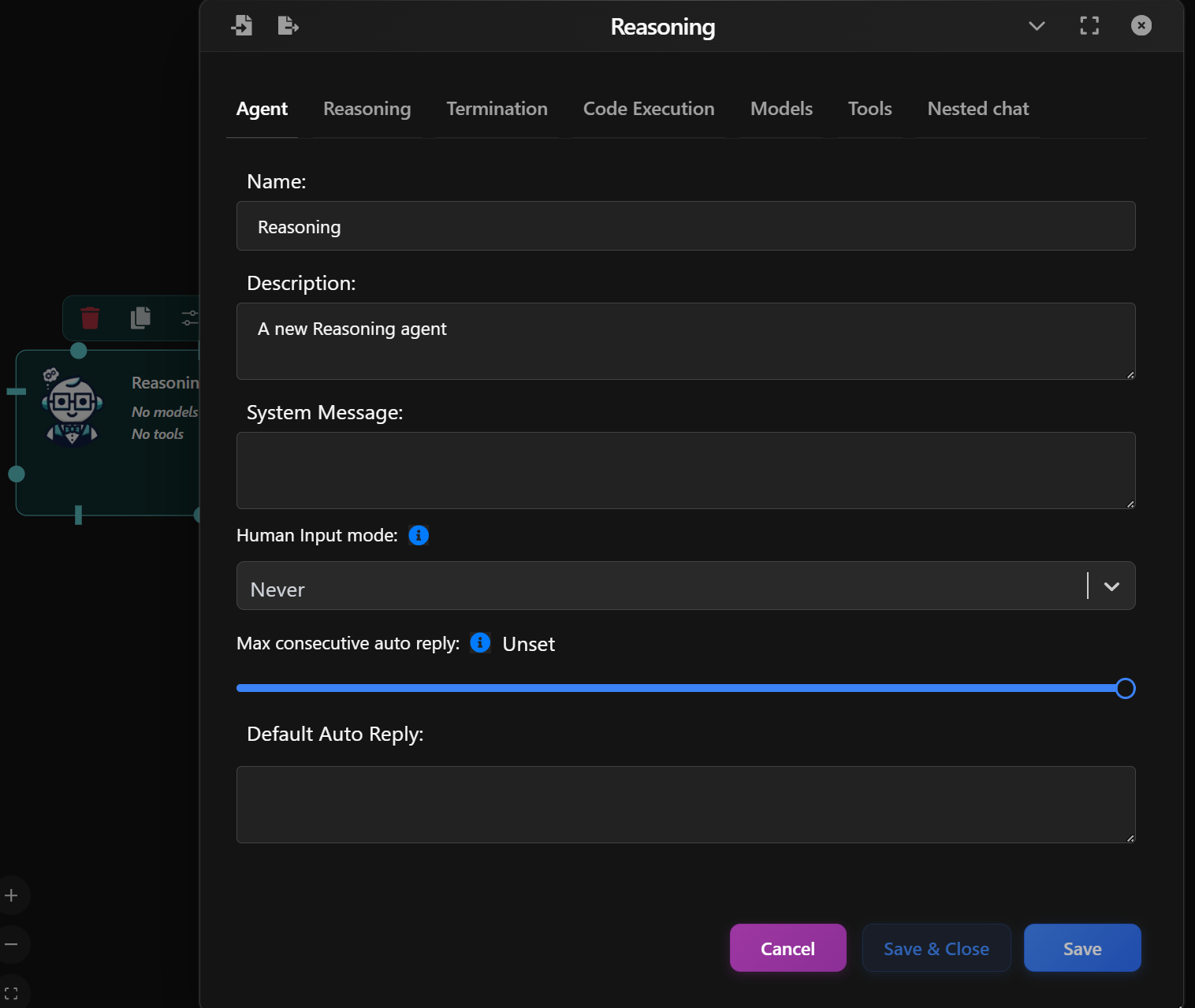
In the Reasoning tab, you can choose the search strategy and fine-tune how reasoning paths are explored.
- Verbose: When enabled, the agent provides insights into its internal decision-making process (great for debugging or teaching).
- Reasoning Method: Choose how reasoning paths are explored:
- Beam Search: Prioritizes best candidates at each step.
- Monte Carlo Tree Search: Simulates and scores multiple paths randomly.
- Language Agent Tree Search: A hybrid search using agents.
- Depth First Search: Explores one branch fully before backtracking.
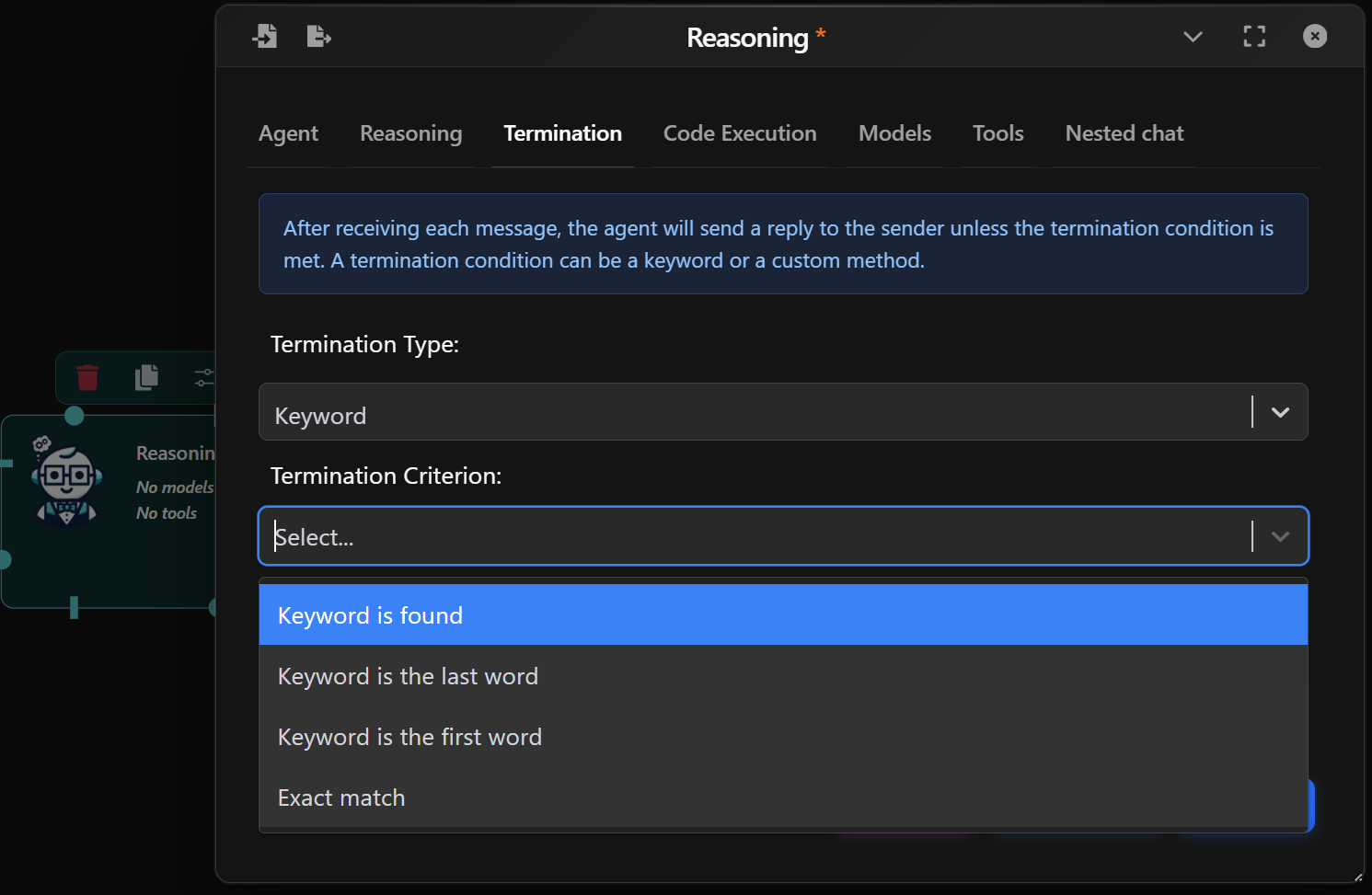
Termination Conditions
Control if and when the Agent should stop responding:
- By Keyword: Stop when specific keywords are found (e.g., “stop”, “done”).
- By Method: Use a custom Python function to decide when to stop.
Examples:
- "Keyword is found" — stops when a phrase appears.
- "Exact match" — stops only if the reply is exactly the keyword.
Code Execution Settings
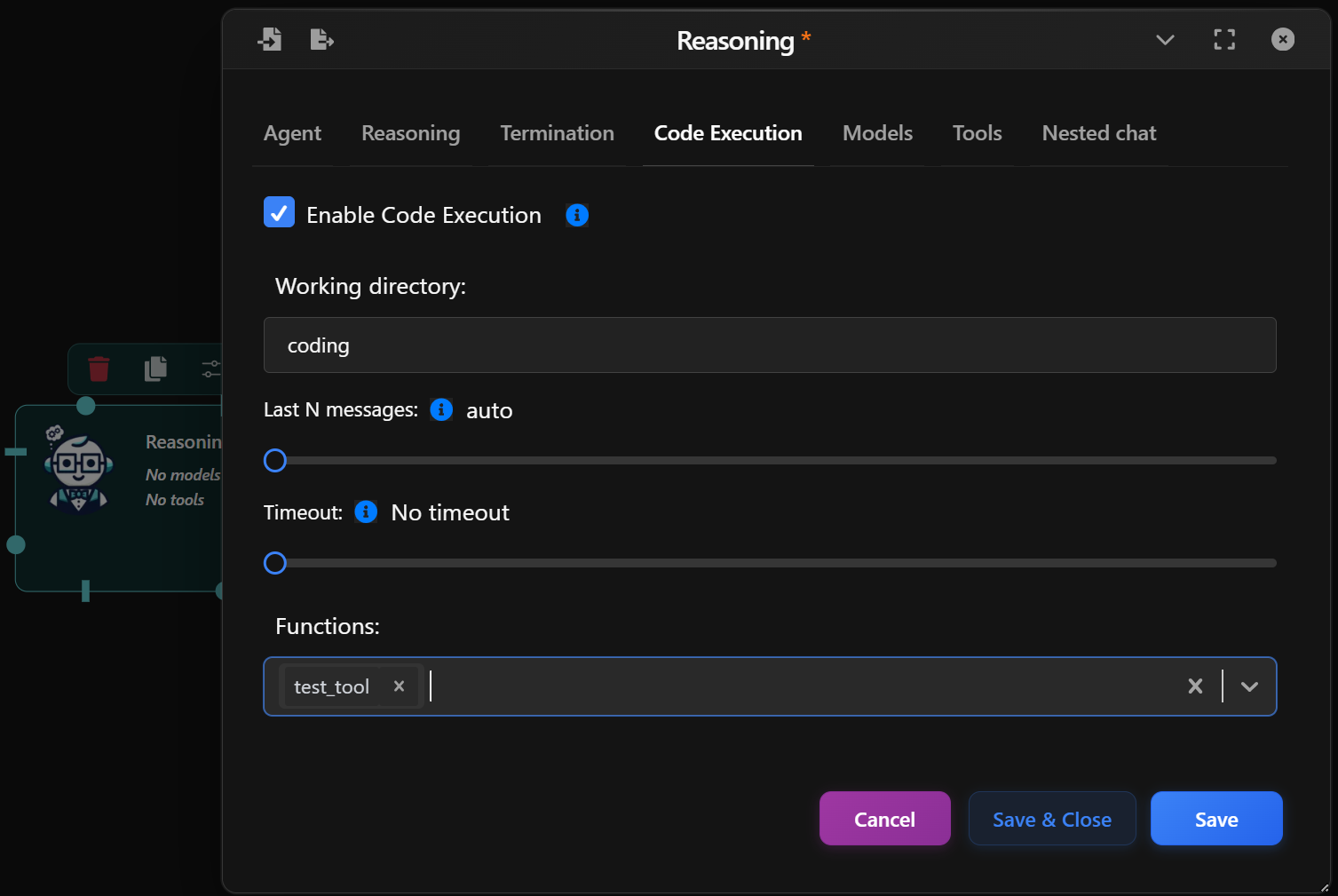
In the Code Execution tab:
- Enable Code Execution: Allows the Agent to execute Python snippets (for testing flows or simulating dynamic behavior).
- Working Directory: Specify where any temporary code files should be executed.
- Last N Messages: Determines how many previous messages should be included as context. Auto will use all available.
- Timeout: Optional timeout to prevent long-running code.
This is useful for simulating scenarios where a user performs code-based tasks or replies with dynamically computed results.
Model Configuration
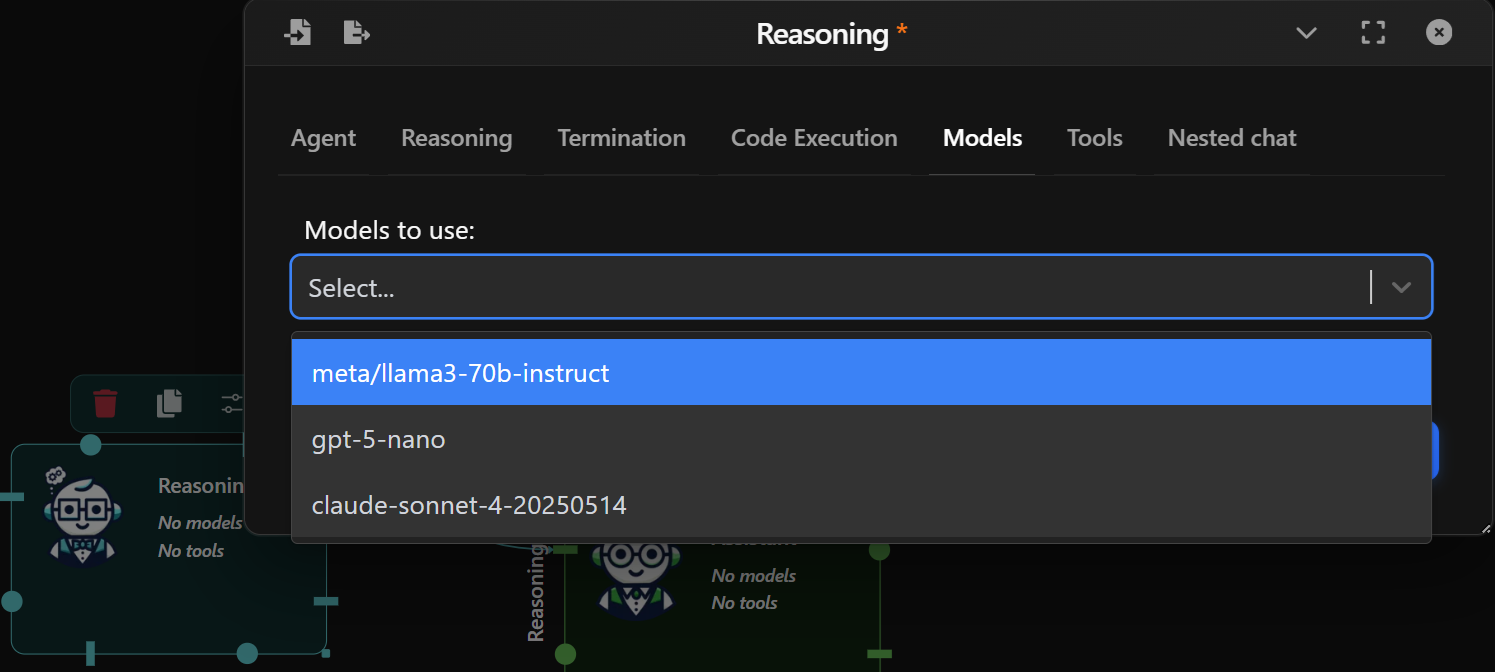
In the Models tab:
- Model Selection: Choose a language model (e.g. gpt-4.1) to power your agent.
- You can assign different models to different agents for flexibility.
For a deeper overview of available models and configuration options, check the Models Guide.
Tools
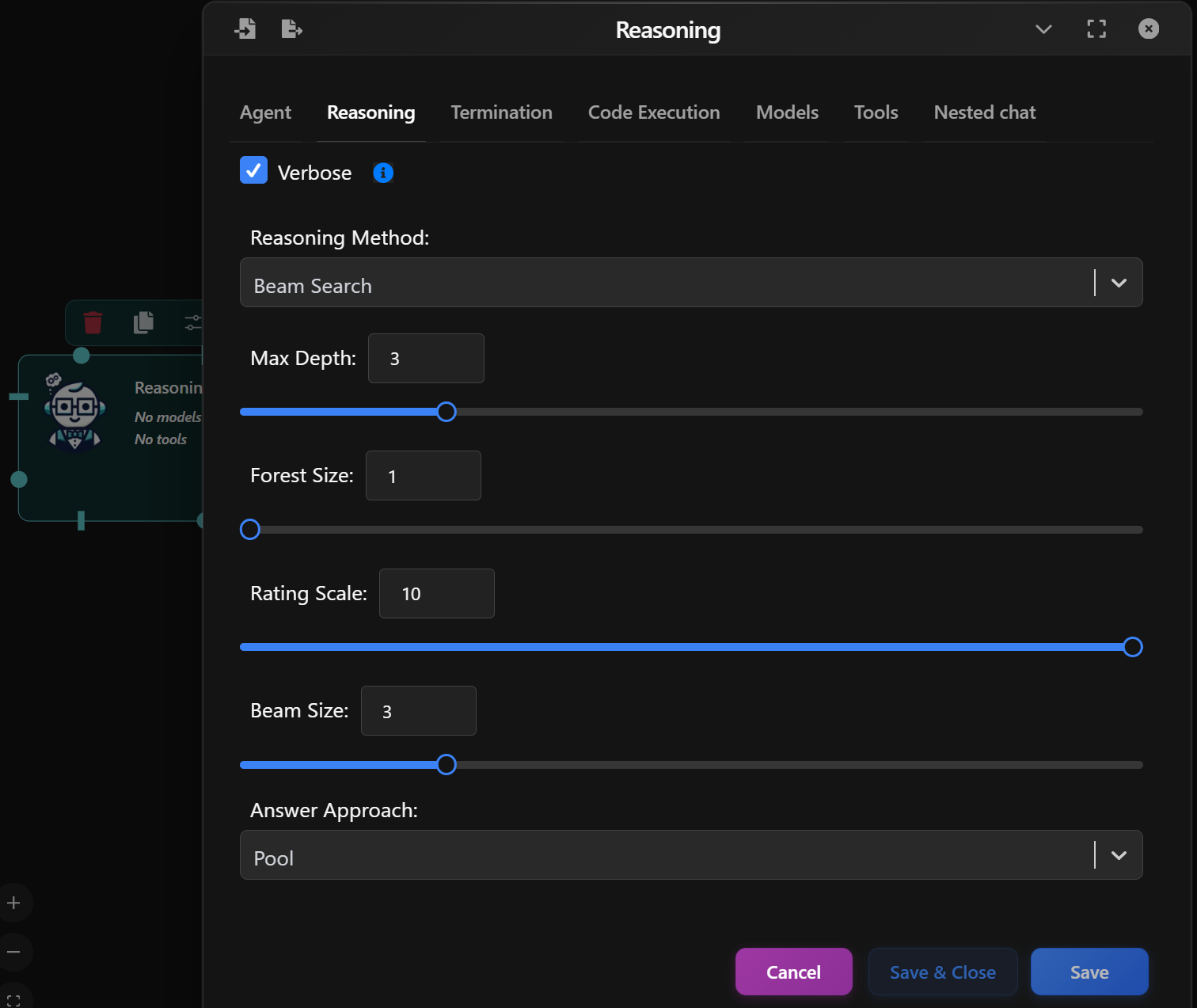
Reasoning Agents can use tools (e.g., search, calculations, APIs) with executors (other agents like User or Assistant) that run them.
- Tool: Choose a defined tool from your system.
- Executor: Select which agent will handle the tool execution.
- Add to bind the tool to this assistant.